
Further observations about physics – split files
(31)Thoughts on Distance and Time vectors
The idea that light energy can be "entangled" into what we regard as electron positron pairs is intriguing because it opens out a different perspective to explore. I have already conjectured that a "photon" pair can interact to create a (rectified) electron and a (rectified) positron pair. For convenience I'll use e-po to signify this (truly) entangled entity. However, when these are created in a universe/antiverse reflected pair the photonic umbilicus consists of light moving from electron to positron and vice versa in a "contra-rotation" (perhaps better described as a contra-flow). The effect is for the rectified elements (the electron and positron) to appear to flow away from each other at, at least, the velocity of light if not twice the velocity of light. What is the vector? It is directly in to and out of the connecting e-po umbilicus. This results in a separation and transformation of the classic 3-distance-dimensional (universal) vectors into a strange new set of 3-time-dimensional vectors. When looked at from the antiversal viewpoint, the emphasis is reversed with any universal distance now looking like a time dimension from the antiversal perspective.
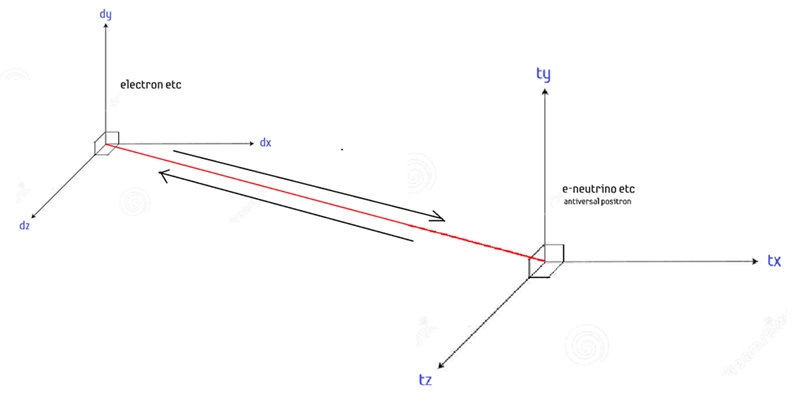
So, what is the vector of this "VoL" (velocity of light)? It is a velocity either vertically into or out of this e-po umbilical tunnel. Where does the tunnel "point" (or lead to)? Well, when you put a lot of electrons together and then create neutrons and protons from them (as they "vortex" into the complex tunnels between universal matter and antiversal antimatter), we start to see the likelihood that there is a proximity-induced electromagnetic attraction across this tunnel, analogous to a Zwitterion effect where, though the overall charge of a molecule is zero, the structural position of internal ions of a molecule results in a polarisation. Universal matter is coated with electrons and (assumedly) antiversal matter is coated with positrons. We don't notice this imbalance until we try to bring two electron shells very close together; then we (metaphorically) "hit a brick wall".
This leads on to a scaling up when we go from one electron to one atom, to a molecule, to a rock, to a comet, to a planet, to a sun, to a neutron star, to a black hole. We can imagine that the the convergence and eventual confluence of these umbilici are short cutting this gravitational well like a "wormhole".
So, what will we perceive to flow into or out of this converging web of gravitational wells? I think that this will be neutrinos (the antiversal representatives of our electrons. One thing that is likely is that the decay from a tau- to a muon- to an electron-neutrino may "flow" in the opposite time direction to what we expect, with electron-neutrinos apparently able to decay into muon-neutrinos and muon-neutrinos apparently able to decay into tau-neutrinos. This could account for the coonfusing observation of neutrino oscillations. It may also be relevant to the high energy neutrinoc that appear to "spring up" into space from beneath the arctic polar cap.
But, don't be confused. The "past" for antiversal matter is a position. The further away it is from its umbilical matter that it is twinned with, the slower the rate of apparent separation will be (its segregation eventually stopping) and it's gravitational effect will be to "paint" a halo around visible matter. Remember that the light wave is an oscillation consisting of a phase of magnetic potential energy alternating with a phase of electric knetic energy. Matter – electrons particularly – reflect a point like phase of kinetic energy because it is moving away from its entanled positron at it's maximum velocity. (See previous Other Observations 30 and remember zitterbewegung that helps to make an "electro-point" seem to be uniunterrupted; that's analogous to the 50 frames/second of a movie or TV screen – we happily perceive it to be continous and not intermittent.)